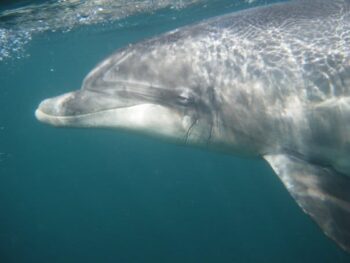
A recent paper published in Ecology and Evolution sought to expand current knowledge of bottlenose dolphin genetics in Ireland by examining individuals that had either stranded along the coast or been sampled while alive at sea. The study also focused on several well-known solitary dolphins, including the most famous of all – Fungie, the Dingle dolphin. DNA samples were collected from several solitary individuals: *Nick, Finn, Dusty, Nimmo and Fungie. The researchers used a range of non-invasive sampling methods to obtain genetic material, including collecting sloughed skin and faecal matter.
Liz Sandeman, who leads Marine Connection’s solitary sociable dolphin project, comments, “The results are particularly fascinating, with four of the five solitary dolphins genetically linked to the Offshore population. Fungie was the exception, showing mixed ancestry from both the Shannon and Offshore populations. It’s wonderful to gain a better understanding of where these much-loved, well-known dolphins have come from. The findings also give us a fresh perspective on solitary dolphins and remind us that we can’t simply assume that an individual appearing inshore has separated from a nearby population.”
“It’s especially interesting to think about dolphins such as Dusty, who has been known over the years to interact with inshore bottlenose dolphins yet never left with them. Knowing that she is genetically linked to the Offshore population makes her story even more intriguing. It leaves us with so many fascinating questions about why Dusty and the other solitary dolphins chose to move into coastal waters in the first place, and what might have brought them there.”
There is clearly still so much more to discover about these remarkable animals! The late Lorenzo de Bonis undertook the study as part of his IMBRsea Master’s thesis at Atlantic Technological University in Galway. Tragically, Lorenzo died while completing the final stages of preparing his research for publication. In recognition of his dedication and hard work, the research team continued with the publication process, ensuring that his work was completed and preserved as part of his lasting legacy.
The open access research paper, published in Methods in Ecology and Evolution, can be read here
*Nick, who stranded in Cork Harbour, Finn in Carlingford Lough, Dusty in North Clare, Nimmo in Galway, and Fungie in Kerry.